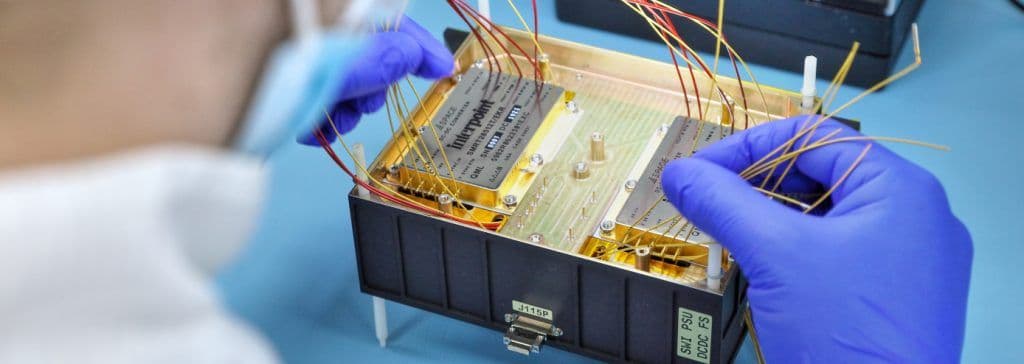
Creotech Quantum S.A. is a Polish company specializing in designing and delivering innovative engineering solutions for the science sector, critical infrastructure, industry, and the globally expanding quantum economy. The company focuses on developing foundational technologies for future quantum infrastructure – from control systems for quantum processors and error correction to solutions enabling secure quantum communication.
The company was established based on the know-how and a team of experts from Creotech Instruments, one of the most recognized Polish companies producing and supplying space technologies, specialized electronics, and scientific instruments to the global market.
Creotech Quantum will debut on the main market of the Warsaw Stock Exchange (GPW) on 17 April 2026.
The company operates in five key segments:
Measurement and Control Instruments, including:
- Sinara / ARTIQ Ecosystem
A control and measurement system enabling management of experiments and quantum processors. It features nanosecond time precision, exceptional speed, and a modular, flexible architecture for rapid system deployment. Thanks to efficient multi-channel readout, low noise, and minimal crosstalk, it ensures stable and reliable control of quantum experiments.
- MTCA Systems
A set of modular components for precise control, synchronization, and data processing/acquisition – particularly in quantum physics and advanced electronics experiments. It supports universal configurations, with the latest standard (MTCA.4) accommodating high-frequency RF applications. Ideal for scenarios requiring sub-nanosecond synchronization and response.
White Rabbit
An ultra-precise time synchronization system for long-distance data transmission. Developed at CERN and fully tested under the demanding conditions of the world’s most powerful hadron collider. Key features include picosecond-level synchronization for large distributed systems and precise timestamping. Carriers and modules are compatible with IEEE 1588 (time synchronization protocol) and SyncE (frequency-synchronized Ethernet).
Advanced sCMOS Cameras
Autonomous, highly sensitive, fast cameras (up to 132 fps for the GSense 6060 sensor in the fastest mode) used in advanced research, including astronomy. Features include rapid preliminary data processing in the camera electronics, exceptionally low noise, high quantum efficiency (above 90%), and high resolution (2048 × 2048 for GSense 2020, 6144 × 6144 for GSense 6060).
Quantum Key Distribution (QKD) System
QKD belongs to the category of information-theoretic security, which can be strictly proven – its operation relies on fundamental quantum physics laws. This solution ensures communication security resistant to quantum computers and any future computational methods.
Business Strategy
The company is transitioning from prototype and first-generation products to large-scale commercialization of its technologies. Its strategy focuses on building a market-leading position across Europe in delivering innovative and reliable solutions for the quantum technology sector.
The company aims to continuously strengthen its competitive advantages through high-quality products and technologies, combined with strong innovation and a broad quantum technology offering.
Market Environment
1. Target Industries:
• Quantum and nuclear laboratories (Big Science, experimental physics)
• Telecommunications
• Critical infrastructure
• Financial sector
• Public administration
• Defense and aerospace
• Logistics
• Automotive
2. Market and Technology Trends:
• Growing importance of quantum technologies, including areas aligned with the company’s operations: quantum computers, quantum cryptography, precision measurements.
Quantum Technology Market
The quantum technology market encompasses several key areas:
• Quantum computing: developing quantum computers and algorithms leveraging quantum phenomena.
• Quantum communication: including quantum key distribution (QKD) and quantum networks ensuring top-level data transmission security.
• Quantum sensing and metrology: enabling highly precise sensors and measurement systems.
• Quantum simulations: supporting design of new structures with unique properties.
The Juniper Research report “Quantum Technology Market Report 2024–2030” forecasts total quantum technology market revenue to grow from $2.7B in 2024 to $9.4B in 2030, a 243% increase. Commercial quantum computing services revenue is expected to reach nearly $10B annually by 2030.
Global public spending on quantum technologies is estimated to have already exceeded $40B, with China, the EU, and the US as leaders.
The EU treats quantum technologies as a strategic area, with flagship programs: Quantum Flagship and EuroQCI (European Quantum Communication Infrastructure).
• Quantum Flagship: a ten-year €1B research and innovation initiative supporting research, commercialization, and startups in sensors, error correction, and quantum architectures.
• EuroQCI: new deployment phase in 2025, focusing on building pan-European quantum infrastructure connecting fiber networks and satellites. Pilots include France, Germany, Italy, and Poland, with the Polish QKD network serving as the Central and Eastern Europe backbone.
EU initiatives are complemented by national strategies developing core competencies in quantum technologies. Total public investments in European countries exceed €8B.
Quantum Computing Instruments and Components Market
According to the MarketsAndMarkets study “Quantum Computing Market with COVID-19 impact by Offering, Deployment, Application, Technology, End-use Industry and Region – Global Forecast to 2026,” the quantum computing market is still in early stages, with projected growth of 30.2% from 2021 to 2026, reaching $1.765B. Key growth drivers include scientific research, banking, finance, and medical applications. National, international, and private R&D projects accelerate market expansion.
High requirements for data security and critical infrastructure (including QKD applications).
The EU-NATO Task Force on the Resilience of Critical Infrastructure – Final Assessment Report (2023) evaluates current security challenges for critical entities and identifies four key sectors: energy, transport, digital infrastructure, and space. It also provides recommendations to enhance the resilience of these sectors.
Development of space and satellite monitoring, e.g., orbital observation using the CreoSky6060 camera.
The latest report on Europe’s space sector, the “ESA Space Economy Report 2023”, published by the European Space Agency (ESA) in December 2024, shows sector revenue of €8.4 billion in 2023, up €200 million from the previous year. Global public investment in the space sector in 2023 totaled €106 billion, with 53% defense-related and 47% civil. ESA itself has increased its budget for 2026 – it will amount to €8.26 billion, compared to €7.68 billion in 2025.
The “ESA Space Environment Report 2024”, published in May 2024, highlights orbital debris: over 1.2 million fragments larger than 1 cm orbit the Earth, including more than 50,000 larger than 10 cm. ESA plans the ClearSpace-1 mission in 2028 to demonstrate active debris removal.
Other critical factors:
• The need for precise time synchronization in distributed systems (White Rabbit technology).
• Automation and robotics in industry, where microsecond-level response is essential (cameras).
3. Macroeconomic and Regulatory Factors
• Research funding from EU, national sources, and Big Science initiatives
• Regulations on security, data protection, and quantum technologies, including the Ministry of Digital Affairs’ “National policies on quantum technology development”
4. Development Prospects
• Growing importance of quantum technologies in practical applications (telecom, finance, defense)
• Potential entry into new segments due to flexible, modular system architecture
5. Opportunities and Challenges
• Opportunities: growing demand for critical infrastructure security, space sector development
• Challenges: global competition, rapid technological change, certification requirements