




Millenion

Modular Industrial Large-scaLE quaNtum Computing with Trapped IONs

IN PROGRESS

We accelerate the development of European quantum computers with specialized control electronics for trapped-ion processors. Our solutions are created within the European Quantum Flagship program, designed to secure Europe’s leadership in the second quantum revolution. We are quantum-ready! 

Quantum Computing

Quantum computers will unlock entirely new applications we can’t yet fully imagine. Even today, it’s clear they will accelerate the development of groundbreaking drugs, optimize highly complex processes (such as large-scale logistics), and drive major advances in artificial intelligence. 

Major U.S. tech companies have been working on quantum computers since the late 20th century. Global interest surged about a decade ago — and Europe has no intention of falling behind. The European Union’s answer is the Quantum Flagship, a €1-billion initiative designed to place Europe at the forefront of the second quantum revolution. 

Within this program, several large-scale projects have been launched across quantum technologies. One of the key initiatives is Millenion. Its aim? To develop scalable trapped-ion quantum computers and reach 1,000 qubits by the end of the decade. (For comparison: most current quantum computers operate with 50–500 qubits.) 

Millenion tackles the critical challenges that quantum computers must overcome to move from laboratory prototypes to industrial-scale systems. The project brings together 14 academic and industrial partners, including Creotech Quantum S.A. 


Creotech’s Role in the Millenion Project

There are many ways to build a quantum computer. One of the most promising relies on highly isolated ions—single, positively charged atoms. In nature, isolated atoms are extremely rare; they usually bind together to form molecules or matter. But single ions are exactly what we need, because each one acts as a qubit, the fundamental unit of quantum information. 

These qubits are ideal: all ions of a given element are inherently identical, unlike superconducting qubits, whose “quantum states” arise from currents and voltages in a circuit rather than from single ions. Ion-based qubits exhibit exceptionally low error rates, with fidelities exceeding 99.9999% in the best implementations. Superconducting qubits rarely surpass 99.9%. That difference is huge: six nines enable hundreds of operations before errors accumulate, while three nines allow only a handful. As a result, a 20-ion quantum computer may deliver a higher quantum volume than a 100-qubit superconducting machine. 

Achieving such fidelity requires the ions to be perfectly isolated, positioned exactly where they should be, and prevented from moving. They must be slowed down and cooled—both electrically and optically—before they can be precisely controlled. Only then can the qubits operate stably and perform calculations as intended. 

Traditional trapped-ion systems support around 20 useful qubits within a single trap. Adding more ions reduces the entanglement between the first and last ions, increasing errors. Scaling therefore requires linking multiple miniature ion traps into subsystems, much like integrating multiple cores into a classical CPU. But unlike classical processors, quantum information can’t be transmitted through standard wires—the qubits must be physically transported between traps so that one “core” can receive the information from another. 

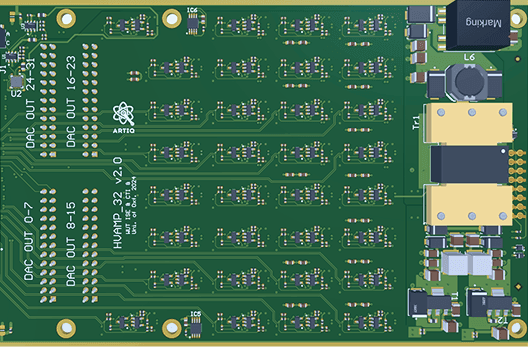
This ion positioning and shuttling is handled by our shuttling control subsystem. It is a real-time electronic system that delivers the DC voltages and control waveforms needed to hold and transport ions. The subsystem includes a custom-designed ASIC located near the quantum processor (which generates control signals) along with control-signal sources, high-voltage amplifiers, low-noise filters, and other critical components. 

At Creotech Quantum, we design electronics tailored to our clients’ needs. Within Millenion, our role is to build a system capable of managing very large numbers of ions—ultimately supporting the project’s ambition of a 1,000-qubit trapped-ion computer. This requires individually controlling thousands of electronic channels with extreme precision. The environment is unforgiving: cryogenic temperatures (4 K), tight spatial constraints, rapid ion shuttling, and the constant battle against electrical noise all pose major challenges. 


It is our responsibility to develop the demanding, specialized electronics required to build a quantum computer—precise, fast, and reliable.

Consortium:

Universität Innsbruck, Alpine Quantum Technologies, Eviden, Consejo Superior de Investigaciones Científicas, Jülich Forschungszentrum, Freie Universität Berlin, Kiutra, Leibniz-Rechenzentrum, QuiX Quantum, Technische Universität München, TOPTICA, Leibniz Universitat Hannover, Johannes Gutenberg-Universität Mainz  

Financing:

Total project value:

199 805 553.70 euro

Project funding amount:

€2 209 803.75

Project duration:

1.02.23-31.08.26

Project website:

www.millenion.eu

Funded by the European Union. Views and opinions expressed are however those of the author(s) only and do not necessarily reflect those of the European Union or or the European Commission. Neither the European Union nor the granting authority can be held responsible for them. 
Challenges Addressed Within Millenion

Scaling quantum processors comes with major hurdles: as the number of qubits grows, the supporting infrastructure grows as well. Every subsystem introduces new technical constraints. 

Ion shuttling requires electrical signals to pass through the hermetically sealed cryostat housing. The wires carrying these signals must then be cooled almost to absolute zero. This increases thermal load, creates design complexity, and raises the risk of cryostat leaks. As the number of control signals increases, so does the risk of crosstalk between them, which can lead to errors in ion control. Additional sources of electrical and thermal noise further degrade qubit coherence. 

In short: the more qubits you add, the harder it becomes to maintain stable conditions and clean signals—both essential for reliable quantum computation. 

To solve this, we are designing a specialized cryogenic ASIC that will operate near the ion trap at a temperature of a few Kelvin. Its job is to generate high-voltage control signals. This solution will allow a greater number of control signals to be delivered to the traps while maintaining the same number of feedthroughs and connections from the outside of the cryostat (control system) to the quantum processor. It is an innovative approach and, with high probability, has no commercially available equivalent. The chip is being designed and tested entirely in Creotech’s laboratories. 

At the same time, the control signals must remain extremely low-noise: even small electrical noise can heat the ions and destroy coherence. To achieve this, we are developing FPGA-based control systems, multi-channel low-noise signal sources, high-voltage amplifiers optimized for minimal noise, and advanced filtering stages. Combined with the custom ASIC, these components will enable a truly large-scale ion-shuttling control system.